Thursday, 26 November 2020

Paris bulletin November 2020

Thanksgiving Day 2020 seems like a suitable date on which to knock out the first Paris bulletin for a long time. The sun is shining out of a clear blue sky and Macron has just announced that the lockdown (‘confinement’) regulations are to be gradually – very gradually for students – loosened, starting from this weekend. Perhaps as ovens are switched on and Thanksgiving dinners are prepared by thousands of ex-pat Americans living here, there are, after all, reasons for other nationalities also to be grateful, to give thanks.  

Sadly I would say that gratitude is not the dominant mood however, or not in Paris where residents don’t only have to cope with the virus, but also the government’s policies of exclusion and harassment of migrants and refugees. It is another klnd of virus, also continuing unabated. As ever, the police are right at the forefront of the action. 


The violent dismantling of the tent city on the place de la République this week showed once again the gulf between the rhetoric – ‘la France, pays des droits de l’homme’ – and the reality. This was a full-scale assault on homeless human beings who had already been viciously ejected from another temporary camp at Porte de la Chapelle. As one of the many supporting protesters put it – ‘They don’t want them to move somewhere else. They want them not to exist’, which in a country still not at peace with its past conflicts, colonial and other, has, or should have, terrifying echoes. A massive demo is planned for this coming Saturday, going from République to the Bastille, those two traditional sites of citizen protest. 


There may not be anything much to be grateful from the government but fortunately at the local level there are things to warm the heart and keep the fabric of community life in reasonable shape. Museums, galleries, cinemas and theatres will all remain shut until mid-December as will bars and cafes. People will still have to carry their individual ‘attestation dérogatoire’when they go out, but where they can go and for how long will be less restrictive than at present. 


It is never easy in a bureaucratic state like France for a spontaneous up-swelling of community activity to take root and flourish, but after months of keeping the refugee breakfasts going, amidst a plethora of difficulties and tensions, we can genuinely celebrate the constancy of les petits déjs solidaires. Which leads me to mention that four of our collectif are currently knitting ‘bonnets solidaires’. We are on the look-out for wool that may be cluttering up your drawers and cupboards, wool we could turn into scarves and hats in cheerful colours to keep off the cold winter weather. Email me at ro597@hotmail.co.uk if you have wool to spare.


At present we are supposed to stay within one kilometre of our home address and, keeping strictly to that rule, I have not been into the centre of the city since late October, either on foot, bike or public transport. Various changes have been made to road usage. Bike lanes that were temporary at first have been made permanent and the Mairie has continued to prioritise public transport over cars. Our own rue Marx Dormoy (see below) is following the trend – a wide and protected bike lane down the middle of the street and a bus-only lane (or meant to be), bringing traffic into the city. 


Being confined is not completely negative. It has taken me into local streets I might well never have bothered to explore and all of them within much less than one kilometre of my flat. You don’t go looking for the assets of a poor neighbourhood in monuments and grand public spaces or even in the domestic architecture. What you get instead of the harmony of fine buildings is the vitality of improvisation and grass-roots initiatives, whether it’s quirky shops, patches of garden or meeting places. 

Lavoir Moderne theatre, rue Léon


fabric shop in the Goutte d'or


                                                    gallery on the rue St Mathieu

remembering the deportation of the Esrikman children


Walls and fences have taken the place of indoor space for exhibitions. We have pedigree goats and sheep along the boulevard de la Chapelle and the work of Korean, Jee Young Lee, on the fence of le Grand Parquet, one of our local theatres. 
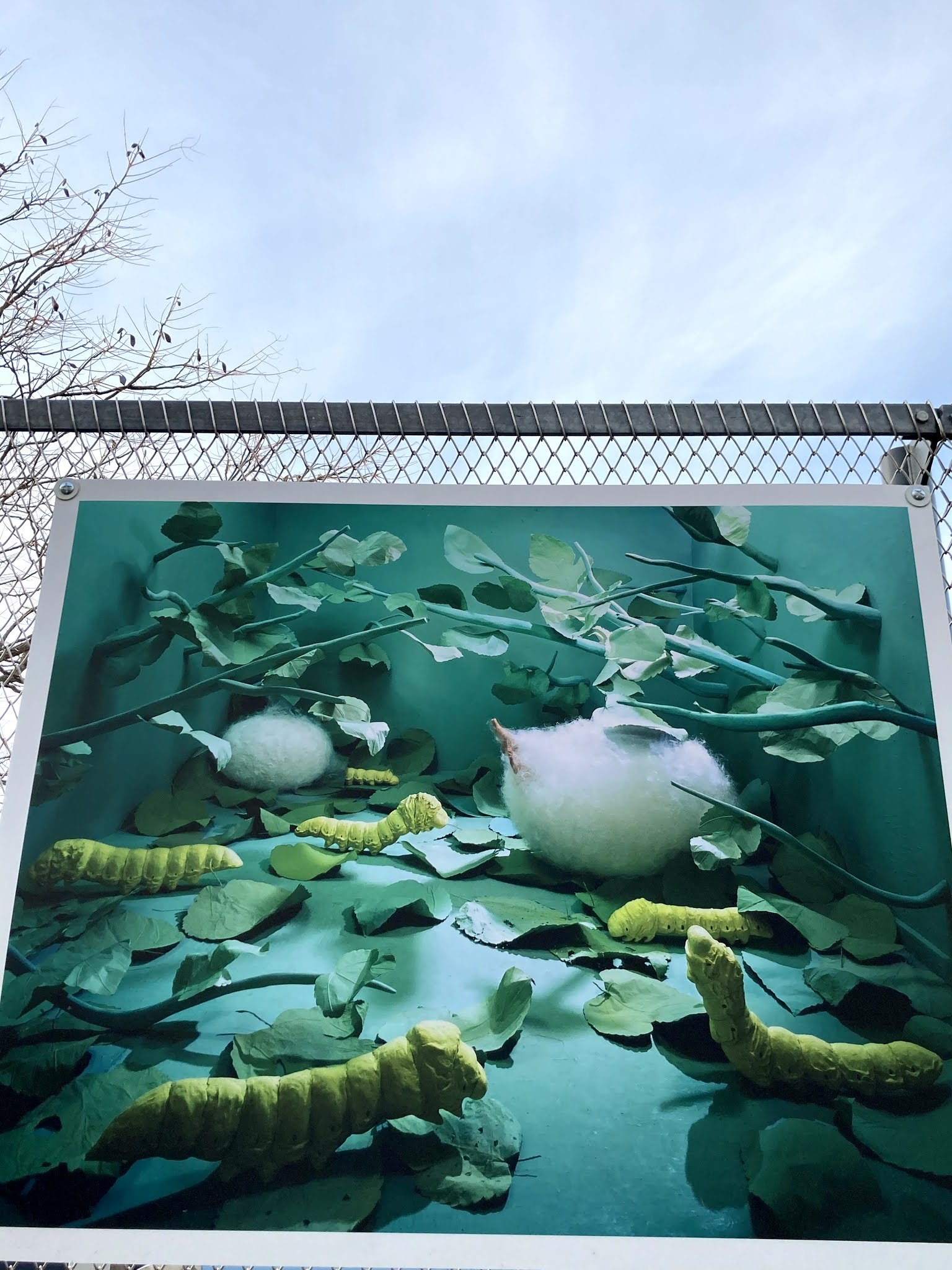

Stage of Mind 1 - Jee Young Lee

Stage of Mind 2 - Jee Young Lee 


Tuesday, 17 December 2019

Paris bulletin December 2019

It is 17th December. France’s general strike continues and today sees the second big demonstration against the proposed reforms to the pension system. I am invited for lunch with friends in a brasserie on the rue de Turenne in the Marais. I set off on foot. There will be no buses going my way and 90% of the metro stations are shut, the iron grilles down on their entrances. It has been like this for a fortnight and neither side shows any sign of giving way. All of us are walking a lot more than we usually do. 

I've put my umbrella in my bag - a wise precaution given how wet this autumn has been - but there's no sign of rain and the temperature is unseasonably high.The bike lanes are busy and there are no bikes sitting idly in their vélib bornes. Some aspects of Paris life are doing OK. Others, like the musées and the shops tell a less positive story. I was in a deserted Pompidou Centre a week ago, had the entire Boltanski exhibition almost entirely to myself and then in the Greco at the Grand Palais yesterday - no need to queue and oceans of space to spend time in front of those extraordinarily modern paintings. 

By the time we part after a very good lunch in the cafe des Musées, crowds of demonstrators are streaming past the café door on their way to République, the start of this particular march. In no time at all and well before I reach the rue de Turbigo which leads into République, I can hardly move forward. I am going against the flow, trying to get across the city and back to Chapelle. Up ahead there is smoke and I wonder for a moment if I’m going to feel the sting of tear gas. There have  been rumours that les black blocks, les anars will be out to ‘make trouble’. No sign at all of them but the chants are growing louder, the drum-beats echoing off the walls. What half an hour ago were handfuls of heavily armoured CRS and police have coalesced into solid black lines, three men deep. On my way to my lunch date I had seen dozens and dozens of white vans of the CRS parked up along the main roads. Since then they’ve turfed their occupants out onto the streets and they’re standing ready, booted and spurred, visors down and batons to hand. 

As I keep pushing through the placards and people I’m thinking about the last demo I was in – 19thOctober the London People’s March for a second vote on Brexit. There were lots of kids at that one. There are none that I can see here. But you wouldn’t bring a child into what feels like a tense and threatening situation. This is no British-style demonstration with men dressed up as teddy-bears and funny hats and joky placards. This demo feels deadly serious - and angry. It has brought together cheminots and social workers, doctors, some in white coats, and teachers - a vast swathe of French society that wants to be heard, that insists it must be heard. But so far isn’t. And that makes me think again of our buoyant hopes on 19th October when another outcome for the UK still seemed possible. 

It is hard to find a Christmas message of love and resilience in among such conflict but that is the main reason for this bulletin in the dying days of 2019. I send you best wishes for 2020. Keep going! Ne lâchez pas! There will be better days ahead. 

Clouds over the Solway Firth 

Monday, 30 September 2019

Paris bulletin September 2019

The last day of September and after more than a year of no Paris bulletins why do I decide that I will write one? Because it feels important to tell a different story from the hate-filled ones that are crowding out the airwaves and the print media. Because however small and insignificant in the grander scheme of things, what I have to tell is important, celebrating growth of a healthier kind. 

On Saturday 28 September in the cour du Maroc where we serve breakfast to hundreds of refugees, asylum-seekers and migrants, we held one of our seasonal fêtes. This one had as its title in French ‘Fête des Vents Porteurs’. Since there is no obvious English translation for ‘les vents porteurs’ it was decided to go with ‘Rise up with the wind’. As it happened the title was appropriate: there was a good breeze which kept the clouds moving on and gave life and energy to our flag and later in the morning to the ‘manches à air’- windsocks - painted on fabric, assembled at one of the many creative workshop tables around the cour, then stuck high up on the fence where they still are, billowing about in the sunshine and rain.

Our new flag - signature red teapot just visible

raising one of the wind socks

Behind that high wire fence stands a recently installed industrial container, still not plumbed in and still without electricity but both promised by the mairie. After three long years of hauling hot water from one friendly café or another we shall finally have the means to heat and wash in situ, to store our provisions and the gifts which well-wishers bring.


mixing the pancakes

recording travels and encounters

There is a point of view that says we are colluding with the authorities by setting up in a fixed cabin as if to become a permanent feature of the neighbourhood.  It is however quite possible to accept the help that we have been lobbying for, while still working energetically towards the underlying objective – to play a part in bringing about a more humane, more intelligent global response to the problem of the thousands (soon to be millions) of dispossessed and exiled who arrive at the borders of wealthy countries. 

As well as getting unwanted publicity about the riots, teargas and grenades, Paris has recently featured in the news as the ‘dirty city of Europe’. It is true that our area – but by no means all areas of the city – struggle to keep the pavements clear of rubbish. We do not have a problem with litter at the breakfasts though. These days we have moved over to using paper cups – more expensive and far from perfect ecologically-speaking since they are plastic-coated on the inside, but better than the plastic ones all the same. We encourage the migrants to keep their cups and reuse them for fill-ups and we provide clearly marked bins for them to throw them into.  There’s not a lot to tidy up once we stop at the end of the morning’s service. 

Speaking a poem

a refugee's painted record of the breakfasts
Continuing this theme, on Sunday afternoon I and eight other people, went out on metro line 7 to Aubervilliers to the community theatre.

Underpinning the play we saw was a simple initial question that had been put to a group of eight migrants – ‘What would you do if we gave you the keys of this theatre?’ What those men, coming from all around the Mediterranean basin and the sub-Saharan countries of Africa, decided to do was to tell their story – under the direction of Richard Maxwell; to bring together a composite picture of the hardship and exploitation they endured on land and sea to get to the ‘promised land’ (where, as noted previously, the pavements turn out to be more litter-strewn than paved in gold). The action of the play moves from the stage to a space high up at the back of the auditorium, thus requiring us all to turn and watch from below as best we can (the intention perhaps being to induce a tiny physical inconvenience - no more than that - into the audience’s experience). It is a tale of endurance, loss and at times sheer terror, but ultimately of triumph. The men now live together in a well-functioning squat in Aubervilliers where, though there is still no security, there is solidarity, determination and energy.

This is not the Paris of teargas and burning bus shelters as featured in the gilets jaunes riots, nor the Paris of the school strikes on Fridays. It’s not the Paris of queues snaking round the pyramid of the Louvre ever since the management changed how people get to look at the Mona Lisa, nor the Paris of the FIAC – the foire internationale de l’art contemporain– where rich people get to spend their excess wealth on objects which someone tells them have ‘investment value’. 

This could be called in Zola-esque terms, the underbelly of Paris, except it’s too bold, too strong to be the underbelly of anything. It is indeed more like un vent porteur. Which thought leads me to the bookshelf once again:

‘Oh wild West Wind, thou breath of Autumn’s being,
Thou, from whose unseen presence the leaves dead,
Are driven like ghosts from an enchanter fleeing,
…
             Drive my dead thoughts over the universe
Like withered leaves to quicken a new birth!
And by the incantation of this verse,

Scatter, as from an unextinguished hearth
Ashes and sparks, my words among mankind!
Be through my lips to unawakened Earth

The trumpet of a prophecy! Oh Wind,
If Winter comes, can Spring be far behind?’

Amen to that, Percy. 

Tuesday, 20 March 2018

Paris bulletin 1 2018

By the time I returned to Paris in mid-January I had decided I wouldn’t begin a new series of bulletins in 2018. But then this weekend we held a meeting of our association, Quartiers Solidaires and suddenly there was something worth sharing again.

We had served breakfasts to about 30 men, most of them familiar faces, one or two new. We’d been back and forth to the squat where we are storing our supplies at present, looking in the boxes for size 40/41/43 shoes, two or three pairs of jeans and gloves. By 10.30 the men had drifted off to spend the rest of the day as best they could. Snow was forecast and the wind was cold.

We - a group of about 15 associés - could have headed off to the café to carry on our discussions. Bob’s Bake Shop is always a welcoming space and not too busy early on a Sunday. But it seemed kind of right to hold the meeting outside, standing around under a grey sky with a few flakes of snow wafting down every now and then. 

We were meeting in response first of all to the latest murmurings from the Mairie du 18ième. They allege they are hearing complaints about our breakfasts from local residents and commerçants. Giving a few men a hot drink and a sandwich on the esplanade ‘fixes’ them, to use the French verb. ‘They hang about and make a mess.’ I didn’t have a camera with me, which was a pity. It would have been good to take a picture of the empty sweep of the esplanade : not a migrant to be seen, no plastic cups or discarded bags, not even a solitary pigeon pecking about.

We needed this meeting to give us new energy after a long, hard winter when our trolley and our little store of food and clothes have been made homeless more than once. The cold air spurred us on. In less than an hour we agreed a number of new and revived initiatives to engage with the people who live and work in this small area. We know that there are far more who are solidaires than not and we need to give that silent majority opportunities to reaffirm and demonstrate their support.

Below is the French text of the manifesto we are putting out in response to the threats from the Mairie. I have followed it with an English text which says roughly the same.  This is just one of our planned ripostes. 

« Faire Vivre la Rue

La rue est à tous ; à nous d’en faire bon usage.

Quartiers Solidaires s’oppose à toute réduction des possibles : nous sommes présents quotidiennement depuis plus d’un an dans les rues de notre quartier pour faire en sorte que tout le monde se sente accueilli et écouté chez nous. Avec une simple table de camping, un caddie de supermarché et le soutien de riverains commerçants et habitants, nous proposons boissons chaudes, renseignements, orientations, vêtements et produits hygiènes en cas de grand besoin. Pendant à peine une heure, et sur un emplacement loin des immeubles, un petit rassemblement de gens de tous horizons se retrouvent pour échanger et se soutenir. C’est modeste, et essentiel : essentiel pour ceux dans la plus grande vulnérabilité, essentiel pour ceux qui souhaitent vivre dans un quartier d’accueil, essentiel pour aborder l’avenir avec optimisme. Nous ne sommes pas près d’y renoncer. »

« Bringing the street to life and life to the street

The street belongs to us all. As citizens we must make good use of it. The association of Quartiers Solidaires is against any attempts to limit the use of public spaces as a places for community and social interaction.

Every day for more than a year the members and friends of Quartiers Solidaires have been reaching out in solidarity to refugees and migrants. We have been able to do this because we have had the active support of local shopkeepers and residents. At times the generosity of strangers has been humbling.

With nothing more than a supermarket trolley, a picnic table and a thermos we have made hundreds of cups of hot coffee and tea and a similar number of sandwiches.  We have given out leaflets with addresses and maps of the city, useful phone numbers and metro tickets. Gifts of soap, shampoo, paper hankies, razors, toothbrushes, shoes, coats, hats and gloves have been passed on to those most in need.

Our picnic table is the opposite of a threat to the wellbeing of the local community. On the contrary, it is a place of exchange and conviviality.  We accept that what we do is very modest but we also recognise its importance, which is why we will not stop what we do.  Quartiers Solidaires in all its diversity asserts that there are better ways to deal with the arrival of strangers in our midst, than by shutting out, cordoning off, incarcerating. »

For more in a similar vein you could look at work of The Good Chance Theatre which was active in the Calais Jungle and for the past six weeks has been working in the Bulle, the reception camp at Porte de la Chapelle less than a mile from where we serve the breakfasts. www.goodchance.org.uk


Good Chance Theatre in the Calais Jungle


N.B. from 16 June this year the National Theatre/Young Vic co-production of the play The Jungle will be on at the Playhouse Theatre, London. More information and tickets at www.thejungleplay.co.uk


Tuesday, 19 December 2017

Paris bulletin 9 2017

I’d been at the exhibition ‘les Chrétiens d’Orient, deux mille ans d’histoire’ and decided to walk back from Institut du Monde Arabe along the quai de la Tournelle, Notre Dame rearing up magnificently solid behind the bare branches of the plane trees and a leaden sky offering a suitable backdrop for a cold December day.

Once upon a time I lived on this side of the river and I knew this part of Paris better: rue de la Clef right beside the Grande Mosquée de Paris and the Jardin des Plantes. But that was 20 years ago and I don’t often revisit these streets. Did I ever walk down the rue de la Bièvre? Probably. It’s a shortcut between the quai and la Place Maubert where there’s a metro station.

Rue de la Bièvre is a modest, domestic sort of road as this 19th century painting shows. 


What you won’t know, unless you are a historian or a lover of old maps, is that once upon a time there was a canal along it - you can see it in the painting in fact, hence the drying laundry. It took water from the Bièvre river to the nearby gardens of the abbey of Saint Victor and the street, its name unchanged, features on some of the oldest maps of the city dating back to the 13th century.

The Bièvre is the second largest river to traverse Paris, although the 21st century passer-by can have no idea it even exists. It was covered over in 1912 and remains entirely hidden from our view, another arm of Paris’s underground drainage and sewage system. But it is a river still and outside the city it looks like a river.


So to the street itself – a narrow thoroughfare, with one or two famous residents at one time and another - Dante for a little while, and more recently François Mitterand who had his private residence at no. 22 between 1972 and 1995. The little square halfway along was renamed after his wife in 2013.

square Danielle Mitterrand


Another day another wander through some more unfamiliar Paris streets, this time rue Jean-Pierre Timbaud, named after the Communist militant and Resistant fighter one of 26 executed by the Germans on 22 October 1941 after the assassination of FeldKommandant Karl Hotz in Nantes.
Jean-Pierre Timbaud
Rue Jean-Pierre Timbaud starts very modestly at the end near metro Couronnes on the boulevard de Belleville and gets progressively more gentrified as you descend it. It hasn’t entirely lost its radical edge however, having la Maison des Métallos partway along it, right opposite one of the many mosques in this part of the city.


This fine building started out in 1881 as a factory manufacturing the best brass instruments in the world, selling trumpets and trombones to America’s greatest jazzmen. In 1937 it was taken over by the Union Fraternelle des Métallurgistes, a branch of the CGT, with a mission to foster ‘social progress’. In this phase of its existence it was the base for a wide range of left-wing political movements, supporting the Republicans in the Spanish Civil war, working with the Resistance, opposing the wars in Algeria and Vietnam and supporting other anti-fascist campaigns. In 1997 the Union was forced to put the building up for sale. Alarmed at the idea that this bastion of resistance and social progress might fall into the hands of private developers, the community came together in a Collecte Interassociatif and with the support of local councillors got the Mairie de Paris to buy the building. Which is how in 2007 la maison des Métallos opened as an établissement culturel de la ville de Paris. It now houses performance spaces, workshops and a café des Métallos. Well worth a visit if you are in the neighbourhood. 

It seems appropriate to stay with the musical instrument theme in ending the last bulletin of this difficult year: the empty manger, the star hidden behind a stifling cloud of CO2 and the heavenly chorus drowned out by the noise of social media. 

Some verses therefore, from a poem for our times.

Learning to Make an Oud in Nazareth

The first day he cut rosewood for the back,
bent sycamore into ribs and made a belly
  of mahogany. Let us go early to the vineyards
  and see if the vines have budded.
The sky was blue over the Jezreel valley
  and the gilt dove shone
above the Church of the Annunciation.
The second day, he carved a camel-bone base
  for the fingerboard.
I sat down under his shadow with delight.

…

My beloved is a cluster of camphire
in the vineyards of Engedi
  and I watched him whittle an eagle-feather, a plectrum
  to celebrate the angel of improvisation
  who dwells in clefts on the Nazareth ridge
where love waits. And grows, if you give it time.
Set me as a seal upon your heart.
On the sixth day the soldiers came
  For his genetic code.
We have no record of what happened.

I was queuing at the checkpoint to Galilee.
I sought him and found him not.
  He’d have been at his open-air workshop –
  I called but he gave me no answer –
The self-same spot
  Where Jesus stood when He came from Capernaum
to teach in a synagogue, and townsfolk tried
to throw Him from the rocks. Until the day break
  and shadows flee away
I will get me to the mountain of myrrh.

The seventh day we set his wounded hands
Around the splinters. Come with me from Lebanon,
  my spouse, look from the top
of Shenir and Hermon, from the lions’ dens.

On the eighth day there were no more days.
I took a class in carpentry and put away the bridal rug.
We started over
With a child’s oud bought on eBay.
  He was a virtuoso of the oud
and his banner over me was love.


Ruth Padel

Monday, 27 November 2017

Paris bulletin 8 2017

The great (in both meanings) exhibition space at the back of our courtyard is always booked by one house or another during the Paris Fashion Week. We’re used to entertaining clusters of emaciated young people all speaking English whatever their native language, cigarette in one hand, phone in the other. However these past weeks we’ve had a rather different clientele. The World Press Photo exhibition is on in there until 7 December, showing the work of the 2017 prizewinners – prints and screens exhibiting ‘the best photo journalism of the year’. We residents of the immeuble don’t often get to join in the jamborees inside this vast interior I look out on from my back room so this is an excellent chance to do so.

As you might imagine, given the state of the world and of planet Earth, there are few photos like this one below, taken by Australian Cameron Spencer, 2nd prize singles. It shows Gaël Monfils in his 4th round match against Andrei Kusnetsov. He needed medical aid after his flight across the court but went on to take the match.


There are others - a man watering flowers in the road, the roof of his house staved in behind him; little girl gymnasts in China flexing their toes. The majority though are scenes of butchery, whether of humans or the natural world: trashed woods, a de-horned dead rhino crumpled in a massive leathery heap in the bush, a turtle tangled up in a mesh of plastic netting; close-ups of frightened, hungry children; a long-distance shot of a man, arms trussed behind his back, hanging limp on the end of a rope, the corpse of a refugee floating in the vastness of the Mediterranean, pinned to the surface by his lifejacket…

And this, a Pietà for our century


Paula Bronstein USA, won 1st prize, Daily Life for this image of Najiba holding 2 year-old Shabir, her nephew, injured by the same bomb that killed his sister on her way to school.

Behind these pictures are the men and women who took them, often at huge risk to themselves. Bearing witness in a time of unprecedented violence and uncertainty.

Other images, other places – Paris is as usual offering more choice of what to see than ever. This month I’ve been to the Anders Zorn at the Petit Palais, a painter I knew nothing of before and whose watercolours are simply extraordinary (until 17 December) 


and the Derain 1904-1914 La décennie radicale at the Pompidou (until 29 January). Others you can see are the The Art of Pastel from Degas to Redon (until 8 April) also at the Petit Palais and Chrétiens d’Orient at the Institut du Monde Arabe (until 14 January) to name only two among dozens. So much - too much? - to see and do.

11 November – la collecte pour notre association. Numbers of us spend most of the day in the local Monoprix, handing out leaflets asking for donations of food for the refugee breakfasts and looking for signatures to a petition for more public toilets in the area – ‘oui, oui, et des douches aussi,’ says one of our supporters.

We gather in the gifts the shoppers leave us with – one huge box after another filled with long-life milk, (assuming we use between 6-9 litres every day we’ll have enough to last long into December), coffee, tea, sugar, jam and chocolate spread. There are a few opposants, one or two elderly people who stop off to tell us it’s deplorable, (that word again…) how we are aiding and abetting ‘la dégradation du quartier’. Mostly the response is positive and sometimes bouleversant in its generosity.

12 November – down on the RER to Port Royal to les Grands Voisins, a temporary experiment in community living and engagement at 82 avenue Denfert-Rochereau in the buildings and grounds of what was until 2012 the hôpital St-Vincent-de-Paul: www.lesgrandsvoisins.org.

Workshops on writing, origami, finding your way in Paris – migrant, visitor or long-time resident - music and noise.


The weather turns colder. The days shorten. One night of wind and the trees at the top of my road have given up their leaves. The public parks are full of chrysanthemums and cineraria.


We are soaked to the skin one morning at the refugee breakfasts. We buy materials and build a canopy for our new trolley – toile cirée, bamboo poles, Velcro. It’s not perfect  but it helps keep the bread dry while we make the sandwiches. One thermos is leaking again and one of the small trolleys has lost a wheel. We hold a bring-and-share AG-dînatoire marking one year of survival, one year of serving enough tea and coffee to fill a lake.  We are a pale reflection of the refugees in this: keeping going, waiting, more in hope than expectation, for better times.


Sunday, 22 October 2017

Paris bulletin 7 2017

This time last year I was in southern California, under skies about as blue and soft as those we have been enjoying in Paris this last while. I recall marvelling at the expenditure of effort and money on all things Hallowe’en – front steps lined with pumpkin lanterns, cauldrons, black cats; witches and skeletons hanging off garage doors and basketball hoops; yards and yards of petro-chemical spider webbery wrapped shroudlike round bushes and hedges. And all those Hallowe’en pop-up shops selling tat, some of it, like the life-size programmable Cerberus dogs I saw in one, costing in the hundreds of dollars.
a typical front yard in a southern Californian home, week of 23 October 2016
There is stuff of that kind to buy in Paris too but the world does not turn orange and black as I felt last year and whenever I am back in the UK in late October. Le Jour des Morts, All Souls’ Day, 1st November is
an important day in the calendar though, the one day of the year when even the least inclined will visit cemeteries to pull weeds from a grave, fill a pot with flowers, leave some chrysanthemums.

Since my last bulletin the Paris Nuit Blanche has been and gone, new exhibitions have opened and one or two have closed again. Gaugin, l’Alchimiste opened at the Grand Palais on 11 October and will run right through almost to the end of January. Anders Zorn is on at the Petit Palais and if you get your skates on you can still just catch the Derain, Balthus and Giacometti, une amitié artistique at the Musée d’Art Moderne de la ville de Paris (ends 29 October).
Giacometti

Derain

Balthus
As usual there’s more than enough for everyone with half an interest in any aspect of the plastic and painterly arts. Not to mention the musical ones, with the Cité de la Musique hosting a big exhibition on Barbara, (1930-1997), probably not a well kennt figure in the anglophone world but much loved and followed in France.

Seeing how fine the weather has been and that these days of golden leaves and pink sunsets will not last much longer I have been making it my business to get out of Paris at least one day a week, to explore the further reaches of the Ile de France on the transilien network. So far I have only done two of my planned routes. The first was to Meaux, better known to many for its cheese (brie de Meaux), than for its church. But the cathedral is very fine and so is the bishop’s palace adjacent to it. You take a train from the Gare de l’Est and before too long you follow the meanders of the river Marne. Jacques-Bénigne Bossuet (1627 – 1704) was bishop there for 23 years, Bossuet who believed in the divine right of kings and the wrongness of Protestantism and devoted much of his career to writing and preaching on those topics. He has a gi-normous statue inside the church and he’s buried there.
 
One of two huge Bossuet statues in the Cathédrale St-Etienne, Meaux 
My second outing was to Dourdan, at the far end of the line D of the RER, a longer and less interesting train-ride, although you do run along side the Orge, another tributary of the Seine, for a short while. The town is quaint, tidy and has an ancient château fort, a free-standing donjon which you can’t visit at present and another very large medieval church with a couple of non-matching spires, slightly reminiscent of Chartres in that respect.

partial view of the church through the inner keep of the château, Dourdan

October saw me make a start in a painting class run by the Mairie de Paris in the primary school on the rue Littré. To begin with it didn’t look promising. Our teacher had extraordinary difficulty with the registration process, leaving us to do 20-minute pencil sketches of a modèle as best we might. That phase is now past. The main external threat is the concierge who must be handled with extreme care. This means we don't leave the building until everyone’s bags are packed, we line up like school children in the yard and wait prayerfully for her to unlock the gate to the street.

Even closer to home the refugee numbers rise and fall like the tide, although this is a tide that never goes out completely. We are still serving food and drink every day to between 100 and 200 hungry men, most of whom have slept outside on the cold earth. There continue to be regular rafles (raids) by the police and far too many reports of their violent (and illegal) removal of people’s covers and other possessions. At that level things don’t look good at all.
Quartiers Solidaires brings up the rear of the demo, Saturday afternoon 21st October 
But at the micro-level of our small efforts it’s not so awful We get to know faces, names, and stories. Every day strangers hand over money, clothes and food. I want to celebrate the gratitude and helpfulness of the refugees and their friendliness, the good-humoured vibe of those doing the serving and the staunch support of a number of local shops and cafes that provide us with bread, hot water, unsold produce and storage space. Serving breakfasts mean you end up with les doigts poisseux and a pile of jam pots for recycling but you have a better day for having done it. You want more good news? Someone is building us a state-of-the-art, custom-made caddie, which judging by the description should be magnificent affair, with an awning. I hope to have a photo of it by the next bulletin.

After the wailing had already begun
along the walls, their ruin certain,
the Trojans fidgeted with bits of wood
in the three-ply doors, itsy-bitsy
pieces of wood, fussing with them.

And began to get their nerve back and feel hopeful.

Bertold Brecht