Monday, 15 February 2021

Paris bulletin 2 2021

Most Mondays I take a ride on the metro to a part of Paris I used to live in, long ago. I walk from Montparnasse-Bienvenue station down the boulevard, crossing both the very long rue de Vaugirard and the more interesting rue du Cherche-Midi. Later in the afternoon heading back to the north of the city I go on foot along the rue de Sèvres, across the boulevard Raspail by the Hotel Lutétia and the boulevard St Germain by the church and through the rue Bonaparte to the Seine, where I catch the 39 bus at the pont du Carrousel. 

The Lutétia was for a long while the only luxury hotel on the Left Bank and, as a result of its location right by St Germain, hosted all the big names of the day inside its Art Nouveau walls: Josephine Baker, Picasso, Peggy Guggenheim and many others. The Nazi Abwehr (counter-espionage) took it over during the Occupation, entertaining some of France’s more notorious collaborators, but after the war De Gaulle, who spent one night there on his way to London, turned it into a centre for displaced persons. At which point it redeemed its reputation to some extent by helping reunite thousands of ex-concentration camp prisoners with their families. It has changed hands several time since, had an extensive make-over in 2018 and is once again entertaining the cultural elite and the rich. Some of them maintain personal suites on the upper floors, decorated to their taste. I don’t think there’s a helipad on the roof but I could be wrong. 


I sometimes call in at the Grande Epicerie across from the hotel on the other side of the jardin Boucicaut. The last time I was there in late January the British shelves were empty apart from a line of Heinz baked beans and a few tins of Birds powered custard. It felt like we were back in the years immediately following the war, whereas the war has really only just begun, as Brexit takes down one UK business after another. (The empty shelves syndrome is manifest in the M&S food outlets too. For a while the one in Châtelet had packets of peanuts in the cold cabinets – a manager with a sense of humour? Last week  those had gone and there was only a forlorn emptiness and one lonely man on the checkouts).


The rue de Sèvres has gone by many names since it was first recorded as a thoroughfare in the 13th century. Then it was the Chemin de la Maladrerie, named thus because there was a leper hospital on the site of the present-day jardin Boucicaut. From one end of the street to the other you can trace some of the great moments of French history. Catholic institutions and churches abound and the hôpital Laennec, now turned into private apartments and a student resident, reminds us of the role French doctors once played in advancing medical science. Laennec was the inventor of the stethoscope. No 17 housed Marc Bloch, the French historian and Resistance fighter for a while. He was shot by the Nazis in the closing months of the war.


The Congregation of the Mission is more fully described as ‘the Society of Apostolic Life of Pontifical Right (for Men)’. The clue is in the word apostolic. Converting the poor to Christianity - Evangelizare pauperibus misit me, (their motto), has been their mission since the society was founded by Saint Vincent de Paul in the early 17th century. 


The chapel on the rue de Sèvres (at no. 97) is hidden behind a modest door onto the street. Step over the threshold though, let the padded door swing shut behind you and you find yourself inside something like an oversized jewellery box, a sumptuously gilded world, as remote as it is possible to be from the favelas and slums where the Lazaristes are most active. 


The congregation boasts at least two other saints beside Vincent himself – both of them have their niches in the chapel and their prayers of gratitude on the walls. Père Clet was strangled in China in the 18th century, Jean-Gabriel Perboyre crucified in the same country a century later.


Once across the boulevard St Germain you are into the small streets leading back from the river. This small quartier, sometimes called ‘le carré des arts’, is all art galleries, fashion houses where entry is by appointment only and nothing in the window has a price tag, Russian dolls and one fine independent bookshop, with sheep in attendance  And on the left is l’Ecole des Beaux Arts, closed to the public during the pandemic. 


The nearly empty 39 bus comes rattling along the rue Bonaparte, swings round onto the quai, picks me and carries me back to my quartier. No Hermès outlet here, no silk pyjamas at 1500 euros a pop, no sequin-spangled tutus, but live music and dancing with the migrants, 


nesting boxes in the trees and home-made soup in the pot. 


Sunday, 10 January 2021

Paris bulletin 1 2021

From where I live in the 18th arrondissement of Paris it looks as though the canal de l’Ourcq could carry you north out of the city, towards Belgium or the Netherlands. In fact not far from the bassin de la Villette the canal bends eastward and broadly follows the line of the river Marne. The water in the canal is not leaving Paris of course – it is flowing, albeit very slowly, into the city from the source of the river Ourcq which rises roughly 90 miles away in the Aisne département. 

The Ourcq canalisé supplies Paris with half its daily requirement of 380,000 cubic metres of water to flush out the sewers and street gutters and irrigate the vegetation in the city parks. It is the bigger but, culturally-speaking, poorer relation of the Canal St Martin which, cutting through the heart of Paris to the Seine, has always had a more glamorous profile (eg. Amélie, Piaf’s ‘les mômes de la cloche’ etc..) But I prefer the canal de l’Ourcq. I particularly prefer it at present because, as you walk away from the city, it offers you a fleeting glimpse of openness and imagined travel to distant places - both sorely lacking in the confinement – and it has its birds, its cormorants especially. 

One chilly afternoon I walked to Villette on ‘my side’ of the canal. I was partly curious to see if the squat I had written about some years ago - wood smoke rising from behind its high fence - was still holding out. It isn’t. It has gone, swept away like most cobbled-together installations that poke out and disrupt the overarching urban narrative of anonymous conformity. What is left is another barren space with a cluster of pillars which are neither interesting nor useful. 

 Still, there is plenty to like on that stretch of the waterway. There are barges which would normally be open for concerts, cafes and books
and there is any amount of wacky, highly coloured mural art – tagging++. There is some interesting domestic architecture too and, tucked away in corners, more tents, because the homeless don’t just go away when their shelters are torn down.
Another day when I walk past the MK2 quai de Seine cinema there are five little blue tents neatly set up by the bike racks. The next time I’m there they’ve all gone. So it goes – the never-ending game of cat and mouse, the reckless, pointless binning in the name of ‘cleanliness’ of all that keeps the rain, frost and wind off people. I have written about that too. You can’t help but return to the same themes if the policies don’t change. 


Are there any tourists at all, a friend asked, in these times of grounded aircraft and half-empty Eurostars? The answer is there are, although many fewer than normal. On New Year’s Day most of them seemed to have congregated up on the butte de Montmartre where the street artists were busy and the chestnut sellers and crêperies doing not bad trade as well. Climbing the steps I came upon a woman in a glossy fur coat – visibly the product of dozens of small deaths. She was exercising a little dog which was clad in a coat with capuche (‘But he doesn’t like having the hood up’ – I quote) and boots on every foot.
Any big city will provide you with such sights but that afternoon the unmistakeable mix of ostentatious wealth and barely concealed loneliness in that dog-walker struck me more forcefully than usual. It was what I had witnessed ten minutes earlier in the église St Bernard that did it.
The church - the one I look out at from my sitting room window - is perhaps best known for its role in 1996 when the resident priest gave sanctuary to a group of illegal immigrants. After weeks of resistance by him and other activists the police stormed the church and removed the men, many of whom were on hunger-strike and very weak. Nothing lasting was achieved after that assault: no check on the gross misuse of force by the police (worse than ever 24 years later), nor a more humane response to the inhabitants of France’s ex-colonies and others seeking refuge. 

This New Year’s Day it wasn’t shouts of defiance that I heard. It was singing. Inside the church was a congregation of between 40 and 50 people from the Democratic Republic of Congo who use the church as their place of worship. The priest was preaching and they were singing in Lingala, the main indigenous language of the DRC. The church was full to bursting with the sound. It was so free, so joyous it made me wish they could take their upswelling voices, the intoxicating beat of their music, out onto the street to send cascades of praise spiralling up and paint the grey skies over Paris in golds and reds and blues.

Bonne année et bonne santé!

Thursday, 26 November 2020

Paris bulletin November 2020

Thanksgiving Day 2020 seems like a suitable date on which to knock out the first Paris bulletin for a long time. The sun is shining out of a clear blue sky and Macron has just announced that the lockdown (‘confinement’) regulations are to be gradually – very gradually for students – loosened, starting from this weekend. Perhaps as ovens are switched on and Thanksgiving dinners are prepared by thousands of ex-pat Americans living here, there are, after all, reasons for other nationalities also to be grateful, to give thanks.  

Sadly I would say that gratitude is not the dominant mood however, or not in Paris where residents don’t only have to cope with the virus, but also the government’s policies of exclusion and harassment of migrants and refugees. It is another klnd of virus, also continuing unabated. As ever, the police are right at the forefront of the action. 


The violent dismantling of the tent city on the place de la République this week showed once again the gulf between the rhetoric – ‘la France, pays des droits de l’homme’ – and the reality. This was a full-scale assault on homeless human beings who had already been viciously ejected from another temporary camp at Porte de la Chapelle. As one of the many supporting protesters put it – ‘They don’t want them to move somewhere else. They want them not to exist’, which in a country still not at peace with its past conflicts, colonial and other, has, or should have, terrifying echoes. A massive demo is planned for this coming Saturday, going from République to the Bastille, those two traditional sites of citizen protest. 


There may not be anything much to be grateful from the government but fortunately at the local level there are things to warm the heart and keep the fabric of community life in reasonable shape. Museums, galleries, cinemas and theatres will all remain shut until mid-December as will bars and cafes. People will still have to carry their individual ‘attestation dérogatoire’when they go out, but where they can go and for how long will be less restrictive than at present. 


It is never easy in a bureaucratic state like France for a spontaneous up-swelling of community activity to take root and flourish, but after months of keeping the refugee breakfasts going, amidst a plethora of difficulties and tensions, we can genuinely celebrate the constancy of les petits déjs solidaires. Which leads me to mention that four of our collectif are currently knitting ‘bonnets solidaires’. We are on the look-out for wool that may be cluttering up your drawers and cupboards, wool we could turn into scarves and hats in cheerful colours to keep off the cold winter weather. Email me at ro597@hotmail.co.uk if you have wool to spare.


At present we are supposed to stay within one kilometre of our home address and, keeping strictly to that rule, I have not been into the centre of the city since late October, either on foot, bike or public transport. Various changes have been made to road usage. Bike lanes that were temporary at first have been made permanent and the Mairie has continued to prioritise public transport over cars. Our own rue Marx Dormoy (see below) is following the trend – a wide and protected bike lane down the middle of the street and a bus-only lane (or meant to be), bringing traffic into the city. 


Being confined is not completely negative. It has taken me into local streets I might well never have bothered to explore and all of them within much less than one kilometre of my flat. You don’t go looking for the assets of a poor neighbourhood in monuments and grand public spaces or even in the domestic architecture. What you get instead of the harmony of fine buildings is the vitality of improvisation and grass-roots initiatives, whether it’s quirky shops, patches of garden or meeting places. 

Lavoir Moderne theatre, rue Léon


fabric shop in the Goutte d'or


                                                    gallery on the rue St Mathieu

remembering the deportation of the Esrikman children


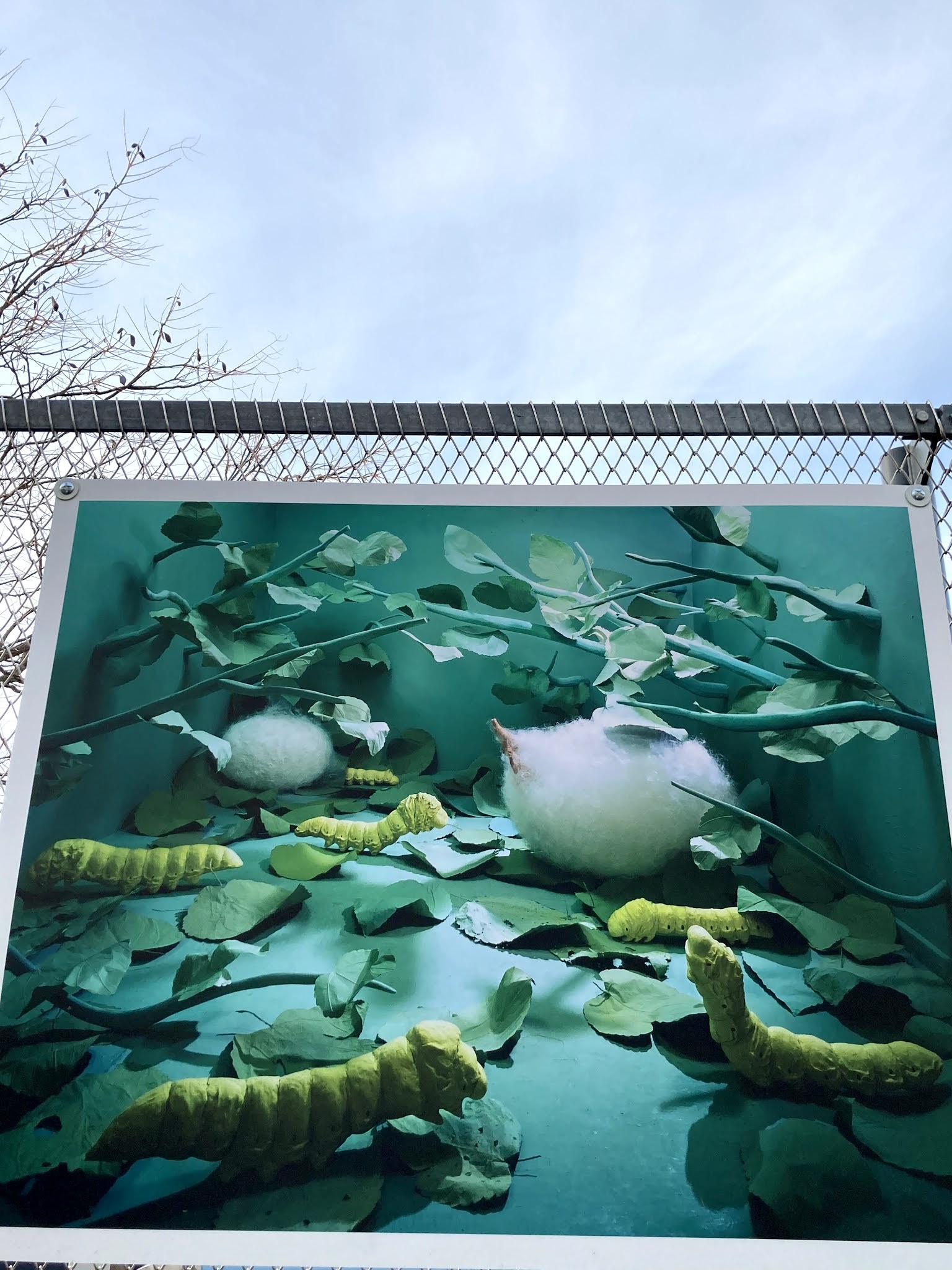
Walls and fences have taken the place of indoor space for exhibitions. We have pedigree goats and sheep along the boulevard de la Chapelle and the work of Korean, Jee Young Lee, on the fence of le Grand Parquet, one of our local theatres. 


Stage of Mind 1 - Jee Young Lee

Stage of Mind 2 - Jee Young Lee 


Tuesday, 17 December 2019

Paris bulletin December 2019

It is 17th December. France’s general strike continues and today sees the second big demonstration against the proposed reforms to the pension system. I am invited for lunch with friends in a brasserie on the rue de Turenne in the Marais. I set off on foot. There will be no buses going my way and 90% of the metro stations are shut, the iron grilles down on their entrances. It has been like this for a fortnight and neither side shows any sign of giving way. All of us are walking a lot more than we usually do. 

I've put my umbrella in my bag - a wise precaution given how wet this autumn has been - but there's no sign of rain and the temperature is unseasonably high.The bike lanes are busy and there are no bikes sitting idly in their vélib bornes. Some aspects of Paris life are doing OK. Others, like the musées and the shops tell a less positive story. I was in a deserted Pompidou Centre a week ago, had the entire Boltanski exhibition almost entirely to myself and then in the Greco at the Grand Palais yesterday - no need to queue and oceans of space to spend time in front of those extraordinarily modern paintings. 

By the time we part after a very good lunch in the cafe des Musées, crowds of demonstrators are streaming past the café door on their way to République, the start of this particular march. In no time at all and well before I reach the rue de Turbigo which leads into République, I can hardly move forward. I am going against the flow, trying to get across the city and back to Chapelle. Up ahead there is smoke and I wonder for a moment if I’m going to feel the sting of tear gas. There have  been rumours that les black blocks, les anars will be out to ‘make trouble’. No sign at all of them but the chants are growing louder, the drum-beats echoing off the walls. What half an hour ago were handfuls of heavily armoured CRS and police have coalesced into solid black lines, three men deep. On my way to my lunch date I had seen dozens and dozens of white vans of the CRS parked up along the main roads. Since then they’ve turfed their occupants out onto the streets and they’re standing ready, booted and spurred, visors down and batons to hand. 

As I keep pushing through the placards and people I’m thinking about the last demo I was in – 19thOctober the London People’s March for a second vote on Brexit. There were lots of kids at that one. There are none that I can see here. But you wouldn’t bring a child into what feels like a tense and threatening situation. This is no British-style demonstration with men dressed up as teddy-bears and funny hats and joky placards. This demo feels deadly serious - and angry. It has brought together cheminots and social workers, doctors, some in white coats, and teachers - a vast swathe of French society that wants to be heard, that insists it must be heard. But so far isn’t. And that makes me think again of our buoyant hopes on 19th October when another outcome for the UK still seemed possible. 

It is hard to find a Christmas message of love and resilience in among such conflict but that is the main reason for this bulletin in the dying days of 2019. I send you best wishes for 2020. Keep going! Ne lâchez pas! There will be better days ahead. 

Clouds over the Solway Firth 

Monday, 30 September 2019

Paris bulletin September 2019

The last day of September and after more than a year of no Paris bulletins why do I decide that I will write one? Because it feels important to tell a different story from the hate-filled ones that are crowding out the airwaves and the print media. Because however small and insignificant in the grander scheme of things, what I have to tell is important, celebrating growth of a healthier kind. 

On Saturday 28 September in the cour du Maroc where we serve breakfast to hundreds of refugees, asylum-seekers and migrants, we held one of our seasonal fêtes. This one had as its title in French ‘Fête des Vents Porteurs’. Since there is no obvious English translation for ‘les vents porteurs’ it was decided to go with ‘Rise up with the wind’. As it happened the title was appropriate: there was a good breeze which kept the clouds moving on and gave life and energy to our flag and later in the morning to the ‘manches à air’- windsocks - painted on fabric, assembled at one of the many creative workshop tables around the cour, then stuck high up on the fence where they still are, billowing about in the sunshine and rain.

Our new flag - signature red teapot just visible

raising one of the wind socks

Behind that high wire fence stands a recently installed industrial container, still not plumbed in and still without electricity but both promised by the mairie. After three long years of hauling hot water from one friendly café or another we shall finally have the means to heat and wash in situ, to store our provisions and the gifts which well-wishers bring.


mixing the pancakes

recording travels and encounters

There is a point of view that says we are colluding with the authorities by setting up in a fixed cabin as if to become a permanent feature of the neighbourhood.  It is however quite possible to accept the help that we have been lobbying for, while still working energetically towards the underlying objective – to play a part in bringing about a more humane, more intelligent global response to the problem of the thousands (soon to be millions) of dispossessed and exiled who arrive at the borders of wealthy countries. 

As well as getting unwanted publicity about the riots, teargas and grenades, Paris has recently featured in the news as the ‘dirty city of Europe’. It is true that our area – but by no means all areas of the city – struggle to keep the pavements clear of rubbish. We do not have a problem with litter at the breakfasts though. These days we have moved over to using paper cups – more expensive and far from perfect ecologically-speaking since they are plastic-coated on the inside, but better than the plastic ones all the same. We encourage the migrants to keep their cups and reuse them for fill-ups and we provide clearly marked bins for them to throw them into.  There’s not a lot to tidy up once we stop at the end of the morning’s service. 

Speaking a poem

a refugee's painted record of the breakfasts
Continuing this theme, on Sunday afternoon I and eight other people, went out on metro line 7 to Aubervilliers to the community theatre.

Underpinning the play we saw was a simple initial question that had been put to a group of eight migrants – ‘What would you do if we gave you the keys of this theatre?’ What those men, coming from all around the Mediterranean basin and the sub-Saharan countries of Africa, decided to do was to tell their story – under the direction of Richard Maxwell; to bring together a composite picture of the hardship and exploitation they endured on land and sea to get to the ‘promised land’ (where, as noted previously, the pavements turn out to be more litter-strewn than paved in gold). The action of the play moves from the stage to a space high up at the back of the auditorium, thus requiring us all to turn and watch from below as best we can (the intention perhaps being to induce a tiny physical inconvenience - no more than that - into the audience’s experience). It is a tale of endurance, loss and at times sheer terror, but ultimately of triumph. The men now live together in a well-functioning squat in Aubervilliers where, though there is still no security, there is solidarity, determination and energy.

This is not the Paris of teargas and burning bus shelters as featured in the gilets jaunes riots, nor the Paris of the school strikes on Fridays. It’s not the Paris of queues snaking round the pyramid of the Louvre ever since the management changed how people get to look at the Mona Lisa, nor the Paris of the FIAC – the foire internationale de l’art contemporain– where rich people get to spend their excess wealth on objects which someone tells them have ‘investment value’. 

This could be called in Zola-esque terms, the underbelly of Paris, except it’s too bold, too strong to be the underbelly of anything. It is indeed more like un vent porteur. Which thought leads me to the bookshelf once again:

‘Oh wild West Wind, thou breath of Autumn’s being,
Thou, from whose unseen presence the leaves dead,
Are driven like ghosts from an enchanter fleeing,
…
             Drive my dead thoughts over the universe
Like withered leaves to quicken a new birth!
And by the incantation of this verse,

Scatter, as from an unextinguished hearth
Ashes and sparks, my words among mankind!
Be through my lips to unawakened Earth

The trumpet of a prophecy! Oh Wind,
If Winter comes, can Spring be far behind?’

Amen to that, Percy. 

Tuesday, 20 March 2018

Paris bulletin 1 2018

By the time I returned to Paris in mid-January I had decided I wouldn’t begin a new series of bulletins in 2018. But then this weekend we held a meeting of our association, Quartiers Solidaires and suddenly there was something worth sharing again.

We had served breakfasts to about 30 men, most of them familiar faces, one or two new. We’d been back and forth to the squat where we are storing our supplies at present, looking in the boxes for size 40/41/43 shoes, two or three pairs of jeans and gloves. By 10.30 the men had drifted off to spend the rest of the day as best they could. Snow was forecast and the wind was cold.

We - a group of about 15 associés - could have headed off to the café to carry on our discussions. Bob’s Bake Shop is always a welcoming space and not too busy early on a Sunday. But it seemed kind of right to hold the meeting outside, standing around under a grey sky with a few flakes of snow wafting down every now and then. 

We were meeting in response first of all to the latest murmurings from the Mairie du 18ième. They allege they are hearing complaints about our breakfasts from local residents and commerçants. Giving a few men a hot drink and a sandwich on the esplanade ‘fixes’ them, to use the French verb. ‘They hang about and make a mess.’ I didn’t have a camera with me, which was a pity. It would have been good to take a picture of the empty sweep of the esplanade : not a migrant to be seen, no plastic cups or discarded bags, not even a solitary pigeon pecking about.

We needed this meeting to give us new energy after a long, hard winter when our trolley and our little store of food and clothes have been made homeless more than once. The cold air spurred us on. In less than an hour we agreed a number of new and revived initiatives to engage with the people who live and work in this small area. We know that there are far more who are solidaires than not and we need to give that silent majority opportunities to reaffirm and demonstrate their support.

Below is the French text of the manifesto we are putting out in response to the threats from the Mairie. I have followed it with an English text which says roughly the same.  This is just one of our planned ripostes. 

« Faire Vivre la Rue

La rue est à tous ; à nous d’en faire bon usage.

Quartiers Solidaires s’oppose à toute réduction des possibles : nous sommes présents quotidiennement depuis plus d’un an dans les rues de notre quartier pour faire en sorte que tout le monde se sente accueilli et écouté chez nous. Avec une simple table de camping, un caddie de supermarché et le soutien de riverains commerçants et habitants, nous proposons boissons chaudes, renseignements, orientations, vêtements et produits hygiènes en cas de grand besoin. Pendant à peine une heure, et sur un emplacement loin des immeubles, un petit rassemblement de gens de tous horizons se retrouvent pour échanger et se soutenir. C’est modeste, et essentiel : essentiel pour ceux dans la plus grande vulnérabilité, essentiel pour ceux qui souhaitent vivre dans un quartier d’accueil, essentiel pour aborder l’avenir avec optimisme. Nous ne sommes pas près d’y renoncer. »

« Bringing the street to life and life to the street

The street belongs to us all. As citizens we must make good use of it. The association of Quartiers Solidaires is against any attempts to limit the use of public spaces as a places for community and social interaction.

Every day for more than a year the members and friends of Quartiers Solidaires have been reaching out in solidarity to refugees and migrants. We have been able to do this because we have had the active support of local shopkeepers and residents. At times the generosity of strangers has been humbling.

With nothing more than a supermarket trolley, a picnic table and a thermos we have made hundreds of cups of hot coffee and tea and a similar number of sandwiches.  We have given out leaflets with addresses and maps of the city, useful phone numbers and metro tickets. Gifts of soap, shampoo, paper hankies, razors, toothbrushes, shoes, coats, hats and gloves have been passed on to those most in need.

Our picnic table is the opposite of a threat to the wellbeing of the local community. On the contrary, it is a place of exchange and conviviality.  We accept that what we do is very modest but we also recognise its importance, which is why we will not stop what we do.  Quartiers Solidaires in all its diversity asserts that there are better ways to deal with the arrival of strangers in our midst, than by shutting out, cordoning off, incarcerating. »

For more in a similar vein you could look at work of The Good Chance Theatre which was active in the Calais Jungle and for the past six weeks has been working in the Bulle, the reception camp at Porte de la Chapelle less than a mile from where we serve the breakfasts. www.goodchance.org.uk


Good Chance Theatre in the Calais Jungle


N.B. from 16 June this year the National Theatre/Young Vic co-production of the play The Jungle will be on at the Playhouse Theatre, London. More information and tickets at www.thejungleplay.co.uk


Tuesday, 19 December 2017

Paris bulletin 9 2017

I’d been at the exhibition ‘les Chrétiens d’Orient, deux mille ans d’histoire’ and decided to walk back from Institut du Monde Arabe along the quai de la Tournelle, Notre Dame rearing up magnificently solid behind the bare branches of the plane trees and a leaden sky offering a suitable backdrop for a cold December day.

Once upon a time I lived on this side of the river and I knew this part of Paris better: rue de la Clef right beside the Grande Mosquée de Paris and the Jardin des Plantes. But that was 20 years ago and I don’t often revisit these streets. Did I ever walk down the rue de la Bièvre? Probably. It’s a shortcut between the quai and la Place Maubert where there’s a metro station.

Rue de la Bièvre is a modest, domestic sort of road as this 19th century painting shows. 


What you won’t know, unless you are a historian or a lover of old maps, is that once upon a time there was a canal along it - you can see it in the painting in fact, hence the drying laundry. It took water from the Bièvre river to the nearby gardens of the abbey of Saint Victor and the street, its name unchanged, features on some of the oldest maps of the city dating back to the 13th century.

The Bièvre is the second largest river to traverse Paris, although the 21st century passer-by can have no idea it even exists. It was covered over in 1912 and remains entirely hidden from our view, another arm of Paris’s underground drainage and sewage system. But it is a river still and outside the city it looks like a river.


So to the street itself – a narrow thoroughfare, with one or two famous residents at one time and another - Dante for a little while, and more recently François Mitterand who had his private residence at no. 22 between 1972 and 1995. The little square halfway along was renamed after his wife in 2013.

square Danielle Mitterrand


Another day another wander through some more unfamiliar Paris streets, this time rue Jean-Pierre Timbaud, named after the Communist militant and Resistant fighter one of 26 executed by the Germans on 22 October 1941 after the assassination of FeldKommandant Karl Hotz in Nantes.
Jean-Pierre Timbaud
Rue Jean-Pierre Timbaud starts very modestly at the end near metro Couronnes on the boulevard de Belleville and gets progressively more gentrified as you descend it. It hasn’t entirely lost its radical edge however, having la Maison des Métallos partway along it, right opposite one of the many mosques in this part of the city.


This fine building started out in 1881 as a factory manufacturing the best brass instruments in the world, selling trumpets and trombones to America’s greatest jazzmen. In 1937 it was taken over by the Union Fraternelle des Métallurgistes, a branch of the CGT, with a mission to foster ‘social progress’. In this phase of its existence it was the base for a wide range of left-wing political movements, supporting the Republicans in the Spanish Civil war, working with the Resistance, opposing the wars in Algeria and Vietnam and supporting other anti-fascist campaigns. In 1997 the Union was forced to put the building up for sale. Alarmed at the idea that this bastion of resistance and social progress might fall into the hands of private developers, the community came together in a Collecte Interassociatif and with the support of local councillors got the Mairie de Paris to buy the building. Which is how in 2007 la maison des Métallos opened as an établissement culturel de la ville de Paris. It now houses performance spaces, workshops and a café des Métallos. Well worth a visit if you are in the neighbourhood. 

It seems appropriate to stay with the musical instrument theme in ending the last bulletin of this difficult year: the empty manger, the star hidden behind a stifling cloud of CO2 and the heavenly chorus drowned out by the noise of social media. 

Some verses therefore, from a poem for our times.

Learning to Make an Oud in Nazareth

The first day he cut rosewood for the back,
bent sycamore into ribs and made a belly
  of mahogany. Let us go early to the vineyards
  and see if the vines have budded.
The sky was blue over the Jezreel valley
  and the gilt dove shone
above the Church of the Annunciation.
The second day, he carved a camel-bone base
  for the fingerboard.
I sat down under his shadow with delight.

…

My beloved is a cluster of camphire
in the vineyards of Engedi
  and I watched him whittle an eagle-feather, a plectrum
  to celebrate the angel of improvisation
  who dwells in clefts on the Nazareth ridge
where love waits. And grows, if you give it time.
Set me as a seal upon your heart.
On the sixth day the soldiers came
  For his genetic code.
We have no record of what happened.

I was queuing at the checkpoint to Galilee.
I sought him and found him not.
  He’d have been at his open-air workshop –
  I called but he gave me no answer –
The self-same spot
  Where Jesus stood when He came from Capernaum
to teach in a synagogue, and townsfolk tried
to throw Him from the rocks. Until the day break
  and shadows flee away
I will get me to the mountain of myrrh.

The seventh day we set his wounded hands
Around the splinters. Come with me from Lebanon,
  my spouse, look from the top
of Shenir and Hermon, from the lions’ dens.

On the eighth day there were no more days.
I took a class in carpentry and put away the bridal rug.
We started over
With a child’s oud bought on eBay.
  He was a virtuoso of the oud
and his banner over me was love.


Ruth Padel